Sunday, September 6, 2015

First Harvest of all things hot!

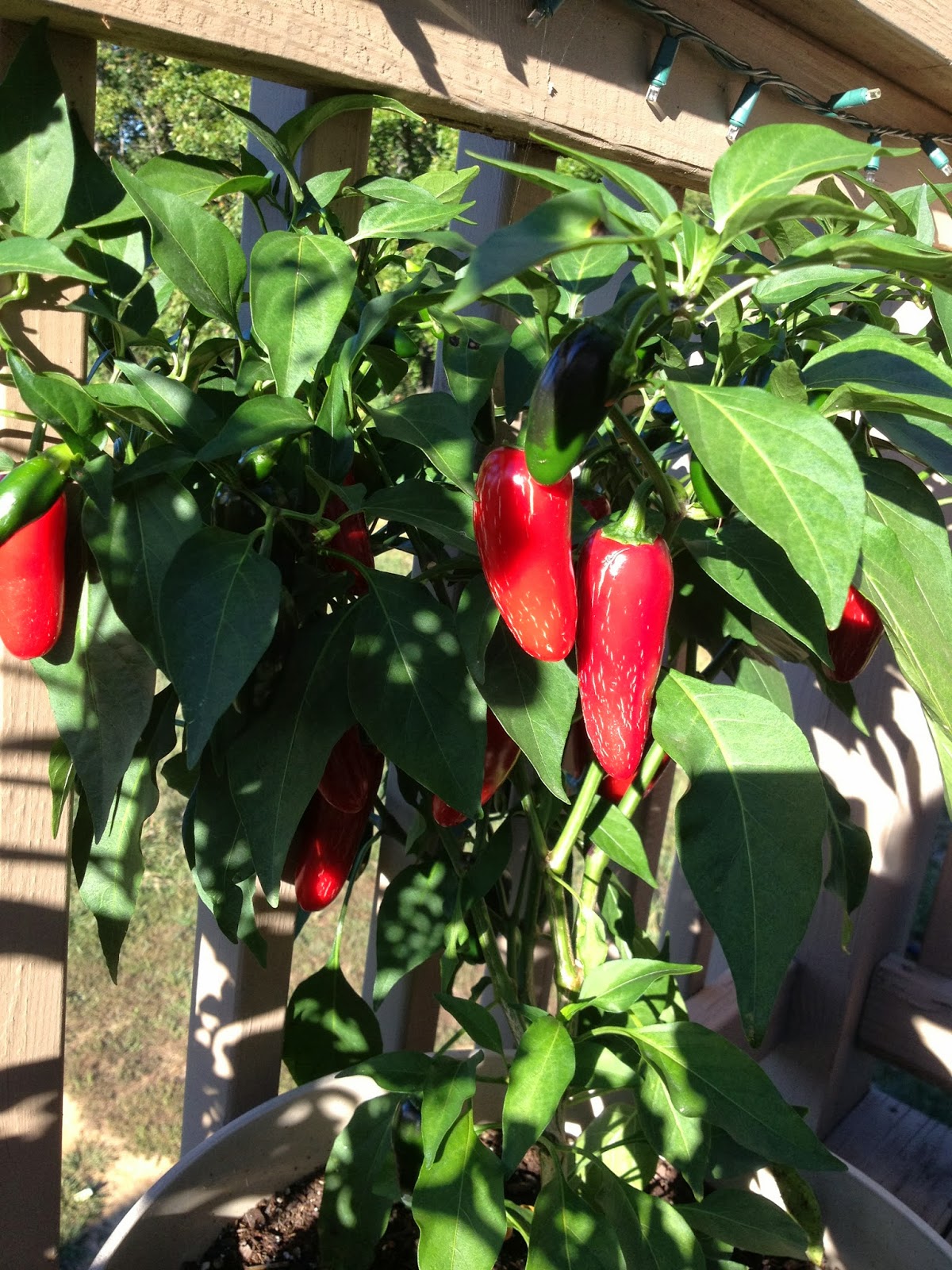
First harvest of the season.
Thai Dragons, Ghosts, Scorpions
More varieties coming soon!


Wednesday, February 4, 2015

Seeds from Ghosts & Reapers

My seeds this year come from Ghost and Carolina Reapers given to us by a friend.  They've sat quietly and dried nicely.  
Now to see what grows!


Fresh Ghost Pepper

Fresh Carolina Reaper Pepper

Monday, March 24, 2014

Yummalicious Jalapeno Creamcheese wrapped with Bacon

Enjoyed these Jalapeno's split in half, filled with cream cheese and then wrapped with bacon, Friday night.
We had them on the grill awhile back, but no pictures.  Plus, they were not pretty.  
These were made in the oven, and look gorgeous.
Paired with a lovely Bud Light Lime beer, is highly recommended.   

Sunday, March 23, 2014

Dreaming of Summer


Thumbing through the garden pictures from last year, made me crave summer.  These jalapeno's are the most beautiful red.  
I very much can not wait!  Hurrrrry Summer Hurrrrry!

Thursday, January 9, 2014

Chili Pepper Grilled Cheese Sandwich


Grilled cheese and chili sandwich.
YUM!
This would go so well with homemade chicken noodle soup on a cold blustery day.
What kind of bread would you use?

Spicy Grilled Cheese

Saturday, January 4, 2014

Happy New Year!

So, 2014 will be my coming out year.  Yes, you read that right.  Coming out with a chili pepper product that we love and hopefully will appeal to the masses.  There are a few things we make and use regularly.  Pizza shake, and jelly.  This year I made habanero and jalapeno jelly.  We haven't made jelly in a couple years, so it was a feat to remember all the ins and outs of the process.  
Looking back at the pictures of the plants, and fresh chili's made me yearn for Spring.  
Can you smell the Spring?

Right now we are just keeping Thai Dragons alive.  None of my Bhut Jolokia plants made it.  I think they were started to late in the season and just couldn't reach maturity in time.  
Stay tuned for the newest starts, in early spring.  

I have an industrial grow light.  Living in this smaller space, prohibits me from using it.  Maybe I'll find a place in the basement.  Until then, its South facing windows for growing babies.  


Saturday, November 30, 2013

Chili Pepper History

Chili peppers have been a part of the human diet in the Americas since at least 7500 BC. There is archaeological evidence at sites located in southwestern Ecuador that chili peppers were domesticated more than 6000 years ago, and were one of the first self-pollinating crops cultivated in Central and South America.


Christopher Columbus was one of the first Europeans to encounter them (in the Caribbean), and called them "peppers" because they, like black and white pepper of the Piper genus known in Europe, have a spicy hot taste unlike other foodstuffs. Upon their introduction into Europe, chilis were grown as botanical curiosities in the gardens of Spanish and Portuguese monasteries. But the monks experimented with the chili culinary potential and discovered that their pungency offered a substitute for black peppercorns, which at the time were so costly that they were used as legal currency in some countries.
Chilies were cultivated around the globe after Columbus. Diego Álvarez Chanca, a physician on Columbus' second voyage to the West Indies in 1493, brought the first chili peppers to Spain and first wrote about their medicinal effects in 1494.
The spread of chili peppers to Asia was most likely a natural consequence of its introduction to Portuguese traders (Lisbon was a common port of call for Spanish ships sailing to and from the Americas) who, aware of its trade value, would have likely promoted its commerce in the Asian spice trade routes then dominated by Portuguese and Arab traders.


There is a verifiable correlation between the chili pepper geographical dissemination and consumption in Asia and the presence of Portuguese traders, India and southeast Asia being obvious examples.
The chili pepper features heavily in the cuisine of the Goan region of India, which was the site of a Portuguese colony (e.g., vindaloo, an Indian interpretation of a Portuguese dish). Chili peppers journeyed from India, through Central Asia and Turkey, to Hungary, where it became the national spice in the form of paprika.
An alternate, although not so plausible account (no obvious correlation between its dissemination in Asia and Spanish presence or trade routes), defended mostly by Spanish historians was that from Mexico, at the time a Spanish colony, chili peppers spread into their other colony the Philippines and from there to IndiaChinaIndonesia. To Japan, it was brought by the Portuguese missionaries in 1542, and then later, it was brought to Korea.


In 1995 archaeobotanist Hakon Hjelmqvist published an article in Svensk Botanisk Tidskrift claiming there was evidence for the presence of chili peppers in Europe in pre-Columbian times. According to Hjelmqvist, archaeologists at a dig in St Botulf in Lund found a Capsicum frutescens in a layer from the 13th century. Hjelmqvist thought it came from Asia. Hjelmqvist also said that Capsicum was described by the Greek Theophrastus (370–286 BCE) in his Historia Plantarum, and in other sources. Around the first century CE, the Roman poet Martialis (Martial) mentioned "Piperve crudum" (raw pepper) in Liber XI, XVIII, allegedly describing them as long and containing seeds (a description which seems to fit chili peppers - but could also fit the long pepper, which was well known to ancient Romans).


Wednesday, November 13, 2013

Chili Pepper spelling and usage

The three primary spellings are chilichile and chilli, all of which are recognized by dictionaries.


  • Chili is widely used in the United States and Canada.  However, it is also commonly used as a short name for chili con carne (literally chili with meat). Most versions are seasoned with chili powder, which can refer to pure dried, ground chili peppers, or to a mixture containing other spices.

  • Chile is the most common Spanish spelling in Mexico and several other Latin American countries,  as well as some parts of the United States and Canada, which refers specifically to this plant and its fruit. In the Southwest United States (particularly northern New Mexico), chile also denotes a thick, spicy, un-vinegared sauce, available in red and green varieties, and served over the local food.

  • Chilli was the original Romanization of the Náhuatl language word for the fruit (chīlli)  and is the preferred British spelling according to the Oxford English Dictionary, although it also lists chile and chili as variants.  Chilli (and its plural chillies) is the most common spelling in Australia, India, Malaysia, New Zealand, Pakistan, Singapore and South Africa


The name of the plant bears no relation to Chile, the country, which is named after the Quechua chin ("cold"), tchili ("snow"), or chilli ("where the land ends").   Chile, Ecuador, Panama, Peru, Dominican Republic and Puerto Rico are some of the Spanish-speaking countries where chilis are known as ají, a word of Taíno origin. There is also some disagreement on the use of the word pepper for chilis because pepper originally referred to the genus Piper, notCapsicum; however this usage is included in English dictionaries, including the Oxford English Dictionary (sense 2b of pepper) and Merriam-Webster.  The word pepper is commonly used in the botanical and culinary fields in the names of different types of chili peppers.

Wednesday, October 30, 2013

Chili Peppers used as crop defense


Conflicts between farmers and elephants have long been widespread in Africa and Asian countries, where pachyderms nightly destroy crops, raid grain houses, and sometimes kill people. Farmers have found the use of chilies effective in crop defense against elephants.   Elephants don't like capsaicin, the chemical in chilies that makes them hot. Because the elephants have a large and sensitive olfactory and nasal system, the smell of the chili causes them discomfort and deters them from feeding on the crops. 

By planting a few rows of the pungent fruit around valuable crops, framers create a buffer zone through which the elephants are reluctant to pass. Chilly-Dung Bombs are also used for this purpose. They are bricks made of mixing dung and chili, and are burned, creating a noxious smoke that keeps hungry elephants out of farmers fields. This can lessen dangerous physical confrontation between people and elephants.

Monday, October 28, 2013

Halloween Decor with a SPICY twist

YES, it has a chili pepper on it.
I am showing it off because I love the ghosts and skull/bones in the background.
Sooooo Halloweeny!

Boooo!

Chili Pepper Nutritional Value


A Chili Pepper a day, keeps the doctor away.
*Take THAT Affordable Health Care Act!*


Red chilies contain large amounts of vitamin C and small amounts of carotene (provitamin A). Yellow and especially green chilies (which are essentially unripe fruit) contain a considerably lower amount of both substances. In addition, peppers are a good source of most B vitamins, and vitamin B6 in particular. They are very high in potassiummagnesium, and iron. Their very high vitamin C content can also substantially increase the uptake of non-heme iron from other ingredients in a meal, such as beans and grains.

Saturday, October 26, 2013

Chili pepper leaves in cuisine


The leaves of every species of Capsicum are edible. Though 
almost all other Solanaceous crops have toxins in their leaves, chile peppers do not. The leaves, which are mildly bitter and nowhere near as hot as the fruit, are cooked as greens in Filipino cuisine, where they are called dahon ng sili (literally "chili leaves"). They are used in the chicken soup, tinola.   In Korean cuisine, the leaves may be used in kimchi.  In Japanese cuisine, the leaves are cooked as greens, and also cooked in tsukudani style for preservation.

Thursday, October 24, 2013

5 Things you didn't know about Srirracha

Hubby's ketchup 


You pass it in the grocery store and see it at restaurants all the time. You might not be able to read all the words on the bottle, but you know what's in it: Sriracha.

The hot sauce in the clear bottle with the rooster on the side is incredibly popular. Quartz recently profiled Huy Fong's founder, David Tran, and learned that Tran is a bit of an accidental entrepreneur. 

Tran, 68, founded Huy Fong 33 years ago with no intention of it going global. Quartz reported that he simply wanted to give V
ietnamese immigrants "a hot sauce worthy of their pho soup."

He did, and then some. Last year, the company racked up $60 million in sales
 and posted a double-digit sales growth percentage. He told Quartz that he has never once raised the wholesale price,
despite inflation having more than tripled the price of food since 1980.

Oh, and Tran doesn't advertise.

Below, five things you may not have known about Tran and his creation.

1. Why the rooster? According to a New York Times article, Tran chose the rooster as the sauce's logo because it is his astrological sign in the Chinese zodiac.

2. Why is it so good? A question that would no doubt flatter Tran, who, according to Quartz, loves reading fan mail. The answer, according to the company's official site, is a bit of letdown, though: High quality ingredients.

3. And how do you pronounce it? It's pronounced, 
SIR-rotch-ah, according to Thrillist. The term is a generic one (like ketchup or mustard), named for the Vietnamese town where it was supposedly created.  Huy Fong, by the way, was the name of the ship that Tran came to the U.S. on.

4. Is it true there's a documentary in the works? Glad you asked. It is true. The project was funded via Kickstarter and is set to hit film festivals this fall. Filmmaker Griffin Hammond calls it "an anthem for sriracha lovers."

5. It's been to spaceA photo from a 2003 mission aboard the International Space Station features two astronauts, 
Yuri I. Malenchenko and Edward T. Lu. See the bottle with the green cap floating by? That's the real stuff. Take that, imitators.


Fall Harvest


Fall Harvest
What would you do with a selection like this?
We would add onion and cilantro with a bit of vinegar... 
and giant bag of taco chips.  


Evolutionary Advantages to Chili Peppers


Birds do not have the same sensitivity to capsaicin, because it targets a specific pain receptor in mammals. Chili peppers are eaten by birds living in the chili peppers' natural range. 


 The seeds of the peppers are distributed by the birds that drop the seeds while eating the pods, and the seeds pass through the digestive tract unharmed. This relationship may have promoted the evolution of the protective capsaicin. 


 Products based on this substance have been sold to treat the seeds in bird feeders to deter squirrels and other mammalian vermin without also deterring birds. Capsaicin is also a defense mechanism against microbial fungi that invade through punctures made in the outer skin by various insects.

Sunday, October 20, 2013

Honorary St. Louis Baseball Contract


Does anyone else have one of these?
It is an honorary contract from the St. Louis Cardinals made out to me. 
I received it when i was born in February of 1967. The Cardinals went on to win the World Series that year with Red Schoendienst and Stan Musial.
Both of their signatures are on here, although I am not sure they officially signed it.
Did anyone else get one of these or am I special? Not the window licking special, tho ; )


Saturday, October 19, 2013

Bring on the spicy hot cocoa

a chilly fall walk..


and a little something to warm you up.  
Spiced Hot Cocoa
Now for a bonfire... 


Friday, October 18, 2013

Winter chili plant migration


Moved the jalapeno and habanero plants into the atrium.  
Threw in the aloe for giggles.
This is the best they will look through the winter.  Hopefully some of the green fruits will still ripen.  
More to come!


Saturday, October 12, 2013

For the gentlemen only ;)

C'mon boys, you know this one is toooooo hot for you!

Scorpion Chili Pepper